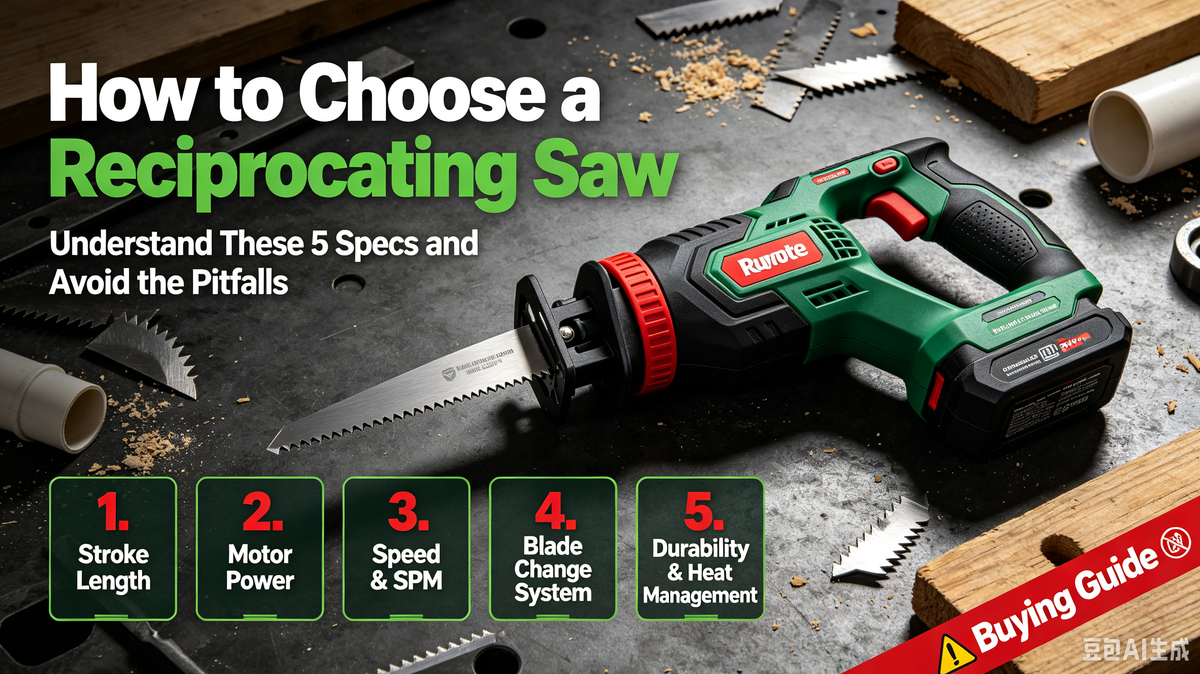

If you could bring only one power tool to a jobsite, many seasoned tradespeople would grab a reciprocating saw. Not because it's the most refined tool in the box, but because it saves the day when nothing else will. You never know what you'll need to cut next—but a recip saw can probably handle it.
This article skips the spec sheet and focuses on real scenarios. By the end, you'll understand why it's earned the nickname "the ultimate jobsite knife."
First, Let's Be Clear: What Makes a Reciprocating Saw So Powerful
The core advantage of a reciprocating saw isn't clean cuts—it's getting into tight spots, cutting through tough materials, and cutting whatever you throw at it.
Its blade moves back and forth in a short stroke at high frequency. It grinds and tears rather than spins. That delivers three practical benefits:
1. It cuts irregular shapes and mixed materials. Wood with embedded nails, PVC pipe with wires running through it, walls hiding rebar—circular saws and cut-off machines either bind up or become dangerous. A recip saw can chew through slowly and safely.
2. It reaches places other tools can't. Pipes flush against walls, framing inside ceiling cavities, bolts sticking out of corners—a circular saw won't fit, but a recip saw slides right in and cuts.
3. Blades are interchangeable and cheap. Wood, metal, plastic, masonry—just swap the blade. One body, multiple materials.
Scenario 1: Demolition—Cutting Studs and Wall Panels
The hardest part of renovating an old house isn't installing new stuff—it's tearing out the old.
Wood studs, light-gauge steel framing, drywall, backer board, ceiling hangers—these are in awkward spots, made of mixed materials, and stubborn. A pry bar is exhausting. A cut-off machine is dangerous. A recip saw slides into the gap, cuts the stud in one pass, and the whole panel comes loose.
Why it works: Demolition doesn't need pretty cuts. It needs speed, less effort, and safety. The recip saw's short stroke and controllability make it safer than anything else in tight spaces.
Scenario 2: Cutting Wood With Nails in It
The most frustrating thing about reclaimed lumber is not knowing what's inside. A circular saw hits a nail and kicks back. A chainsaw hits a nail and ruins the chain. A recip saw with a metal-cutting blade goes right through.
Salvaged beams, pallets, formwork—they're full of nails, screws, even chunks of concrete. This is where the recip saw's tolerance for abuse really shows.
Why it works: Circular saws spin, so they kick back on hard objects. Recip saws reciprocate, so they just slow down. That's a different level of safety.
Scenario 3: Cutting PVC, PPR, and Conduit Pipe
Plumbing and electrical work is where the recip saw dominates.
PVC drain pipe, PPR water pipe, electrical conduit—these are often flush against walls, buried in floors, or stuck in corners. A pipe cutter won't fit. A hand saw is too slow. A recip saw with a fine-tooth blade cuts through in seconds.
More importantly, there might be live wires or water inside. Circular saws and angle grinders are extremely risky in that situation. A recip saw can cut at low speed, slowly and safely.
Why it works: It reaches where other tools can't, and it tolerates foreign objects inside the pipe.
Scenario 4: Cutting Metal Profiles and Bolts
Many people think recip saws only cut wood. With a metal-cutting blade, they'll go through angle iron, square tubing, rebar, and expansion bolts.
Jobsite demands are constant: shortening bolts, resizing angle iron, cutting rebar. An angle grinder cuts metal fast, but it throws sparks and dust, and it's risky in flammable environments. A recip saw cuts metal slower, but it's clean, controllable, and spark-free.
Why it works: In no-fire, no-dust, tight, or elevated scenarios, a recip saw is the safer metal-cutting option.
Scenario 5: Pruning Branches and Landscaping Work
Recip saws hold their own in landscaping too.
Thick branches, roots, shrubs, bamboo—pruning shears struggle, chainsaws are too heavy. A recip saw with a wood blade is one-handed, fits into high spots, dense brush, and tight corners.
Many landscapers keep a cordless recip saw specifically for the spots a chainsaw can't reach and pruners can't cut.
Why it works: Lightweight, one-hand controllable, cheap blades—the "gap tool" of landscaping.
Scenario 6: Emergency Rescue and Breaching
This is the most underrated use of a reciprocating saw.
Car extrication, earthquake rescue, fire breaching—firefighters and rescue teams frequently use recip saws to cut through deformed car doors, rebar, wood structures, and plastic panels. It's not as heavy as hydraulic cutters, and it doesn't need sparks like a cut-off saw. In tight spaces, it cuts through obstacles fast.
Home emergencies are the same: a jammed door, someone trapped under furniture, a burst pipe that needs to be cut fast—a recip saw can save critical minutes.
Why it works: One tool, multiple blades, one-hand operation, mixed-material capability. Emergency scenarios need exactly that "cuts a bit of everything" tool.
Summary: The Recip Saw's "Universal" Appeal Is That It Doesn't Pick Fights
A circular saw cuts wood fast—but not metal. An angle grinder cuts metal hard—but not wood. A pipe cutter cuts pipe clean—but won't fit in corners.
A reciprocating saw isn't the best at any single thing, but it's the only power tool that cuts a little bit of everything. That's where "ultimate jobsite knife" comes from—not because it's the strongest, but because it's the least picky.
If you constantly face jobsites where you don't know what you'll need to cut next, a recip saw deserves a permanent spot in your kit. If you only work with one material in one scenario, a dedicated tool will be more efficient.
A tool's value isn't how powerful it is—it's whether it can get in there and cut when you need it.