
When people think of off-road vehicles, the first things that come to mind are ruggedness, toughness, and the ability to take a beating. But you might not realize that the coating process for off-road vehicles is actually more demanding than for ordinary sedans.
Why? Because off-road vehicles don't just face city roads—they have to withstand desert sun, jungle humidity, saline corrosion, and the direct impact of flying gravel. Their "skin" needs to not only look good but also hold up.
Heavy-Duty Protection Starts from the Inside
The First Line of Defense: Electrophoretic Coating
Many people only care about how shiny the paint is, overlooking the most fundamental layer of protection—the electrophoretic coating.
Before the chassis and body frame are assembled, they go through a critical process: cathodic electrophoretic coating. In simple terms, the entire body is immersed in an electrophoretic paint bath, and an electric current ensures the coating adheres uniformly to every corner—including cavities and gaps that spray guns can't reach.
This process directly determines the body's corrosion resistance lifespan. Salt spray, mud, and de-icing agents—the things off-road vehicles face daily—attack this invisible line of defense first. If the electrophoretic coating isn't done right, no amount of glossy topcoat will save it.
Underbody Armor: The Real "Hardcore" Protection
If the body coating is the "face," then the underbody coating is the "backbone." Off-road vehicle chassis face gravel impacts, scratches, and mud corrosion—ordinary paint simply can't handle it.
There are currently two mainstream underbody anti-corrosion solutions:
-
Zinc-Aluminum-Chromium Coating (Dacromet): A chromium-free anti-corrosion coating technology that provides excellent salt spray resistance, ideal for long-term protection of chassis metal components.
-
Polyurethane Elastomer Coating: Commonly known as "underbody armor" or "anti-impact coating." It acts like an elastic rubber layer that absorbs the energy of gravel impacts while providing excellent chemical resistance and abrasion protection.
These coatings typically require 2K (two-component) polyurethane acrylic paint, applied with specialized spray equipment to achieve the desired hardness and protection.
The Art of Topcoat: Rugged but Not Rough
An off-road vehicle's appearance can be tough, but the coating process leaves no room for shortcuts.
Standard Process: More Than Just One Layer
Like all passenger vehicles, off-road vehicle topcoats consist of primer, intermediate coat, and topcoat layers—each serving a distinct purpose:
| Layer | Function | Description |
|---|---|---|
| Primer | Adhesion + Rust prevention | Bonds with the electrophoretic layer for basic corrosion protection |
| Intermediate Coat | Filling + Chip resistance | Increases film thickness for better impact resistance |
| Topcoat | Color + Gloss + Weatherability | Directly faces UV radiation, acid rain, and scratches |
According to the Chinese standard QC T484-1999 Paint Quality Standard, vehicles priced above RMB 50,000 must have a minimum paint thickness of 120μm. For off-road vehicles that frequently travel on unpaved roads, this is just the "bare minimum."
The Real Challenge: Edges and Gaps
Modern paint shops extensively use robotic sprayers for high precision and quality. But robots have their limitations—door edges, corners, and gaps are areas where consistent coverage is difficult.
At the BAIC off-road vehicle plant, these critical steps are still performed manually by experienced technicians. A seam-sealing technician needs over 10,000 hours of hands-on experience to ensure the coating quality at every edge meets design specifications.
Rugged doesn't mean rough. This principle is fully demonstrated on the coating line.
Specialty Coatings for Off-Road Vehicles
Beyond standard processes, there are several specialized coating solutions in the off-road world worth exploring.
Impact-Resistant Armor Coating
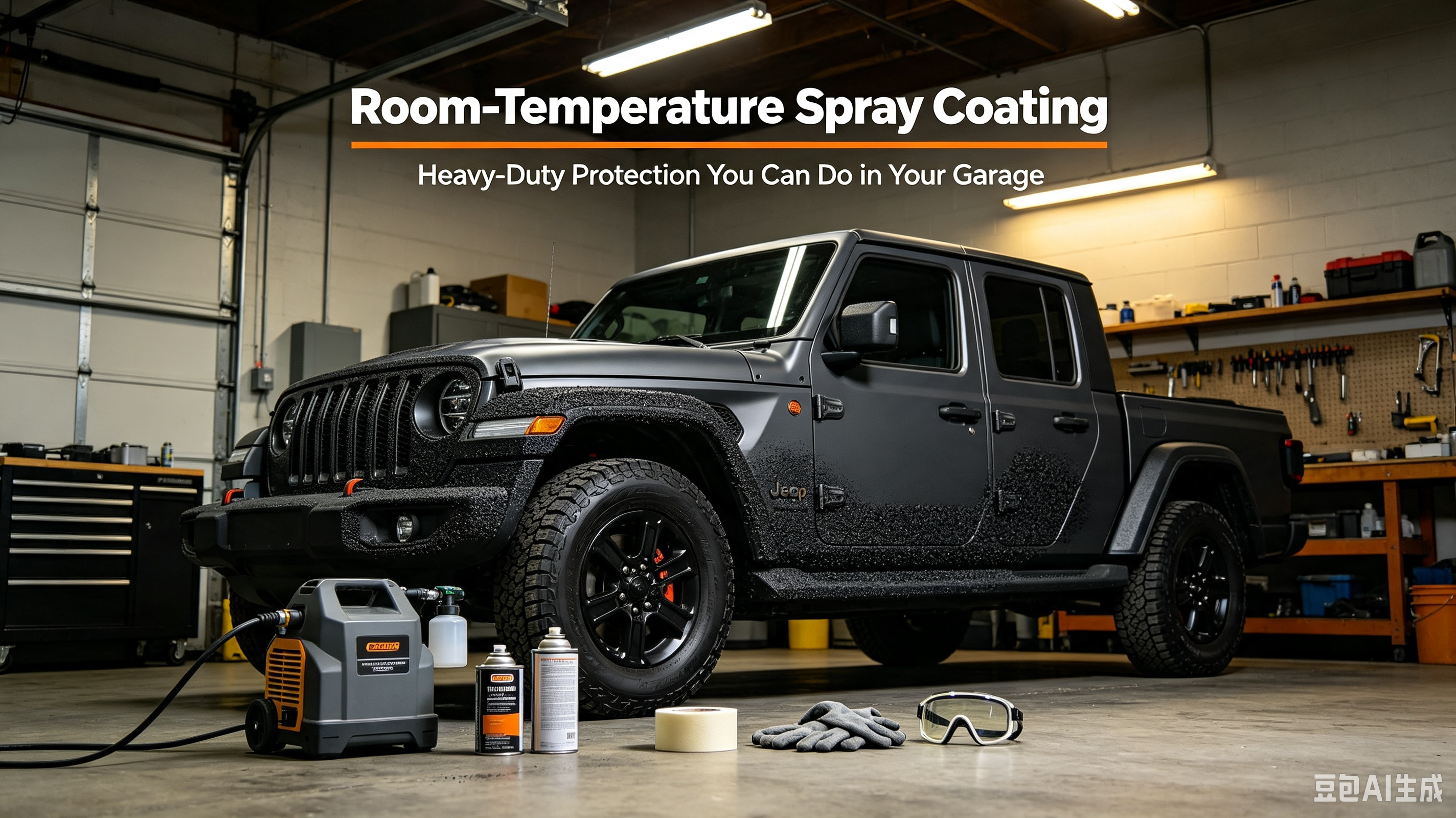
This has become an increasingly popular choice in the off-road modification community in recent years. It's essentially a high-solids polyurethane or epoxy coating that, after application, creates a matte rubber-like texture with a thickness 3-5 times that of conventional automotive paint.
Taking the Yingang Armor coating application process as an example:
-
Substrate Preparation: Sanding, rust removal, and cleaning to ensure a clean, oil-free surface. Rusted areas are first sanded with 80-grit paper, then finished with 200-grit.
-
Primer Application: Primer is applied to bare substrates, then sanded again after drying.
-
Coating Heating: The armor coating is heated to the appropriate temperature, shaken well, and loaded into a specialized spray gun.
-
Spraying & Atomization: Applied by professional technicians, followed by atomization after a 15-minute interval to refine the finish.
-
Curing: Tack-free in just 2-5 minutes, light handling in 30 minutes, full cure in 24 hours.
Key Advantages:
-
Impact Resistance: Stone chips are less likely to penetrate to the primer; minor scratches may even "self-heal"
-
Abrasion Resistance: Brush against bushes or rocky trails without worrying about body damage
-
Unique Texture: Matte/grainy finish enhances the rugged aesthetic
-
Extended Lifespan: Protects the original factory paint, preserving resale value
Textured Coating
Off-road vehicles often aim for a "muscular" visual impression, and texture plays a key role in achieving that look.
Toyoda Gosei developed a coating technology called METEOCOAT in 2025. By creating irregular凹凸 textures on plastic exterior parts, it gives off-road vehicles a more rugged, powerful appearance. Another practical benefit—scratches become far less noticeable.
Peelable Coating
Toyota filed an interesting patent in 2023: peelable paint. This technology allows the outermost layer of the paint to be peeled off by hand, like removing a protective film.
The principle is simple: a special peelable coating is applied over the standard paint. When the outer layer gets scratched by branches or chipped by gravel, the owner can simply peel off this "old skin" to reveal a pristine new surface underneath.
For off-road vehicles that frequently encounter harsh terrain, mass production of this technology could make paint touch-ups remarkably simple.
Coating: The Off-Road Vehicle's First Layer of Armor
The appeal of an off-road vehicle isn't about how pristine it looks when it leaves the showroom—it's about remaining confident on the road after weathering the elements.
And behind that confidence lies a sophisticated coating system—from electrophoretic coating to topcoat, from anti-corrosion to chip resistance—working together as an integrated whole.
So the next time you see an off-road vehicle caked in mud, you'll know that beneath that layer of dirt lies a sophisticated "armor system" that's every bit as refined—if not more so—than that of a standard sedan. Ruggedness is its character; refinement is its nature.