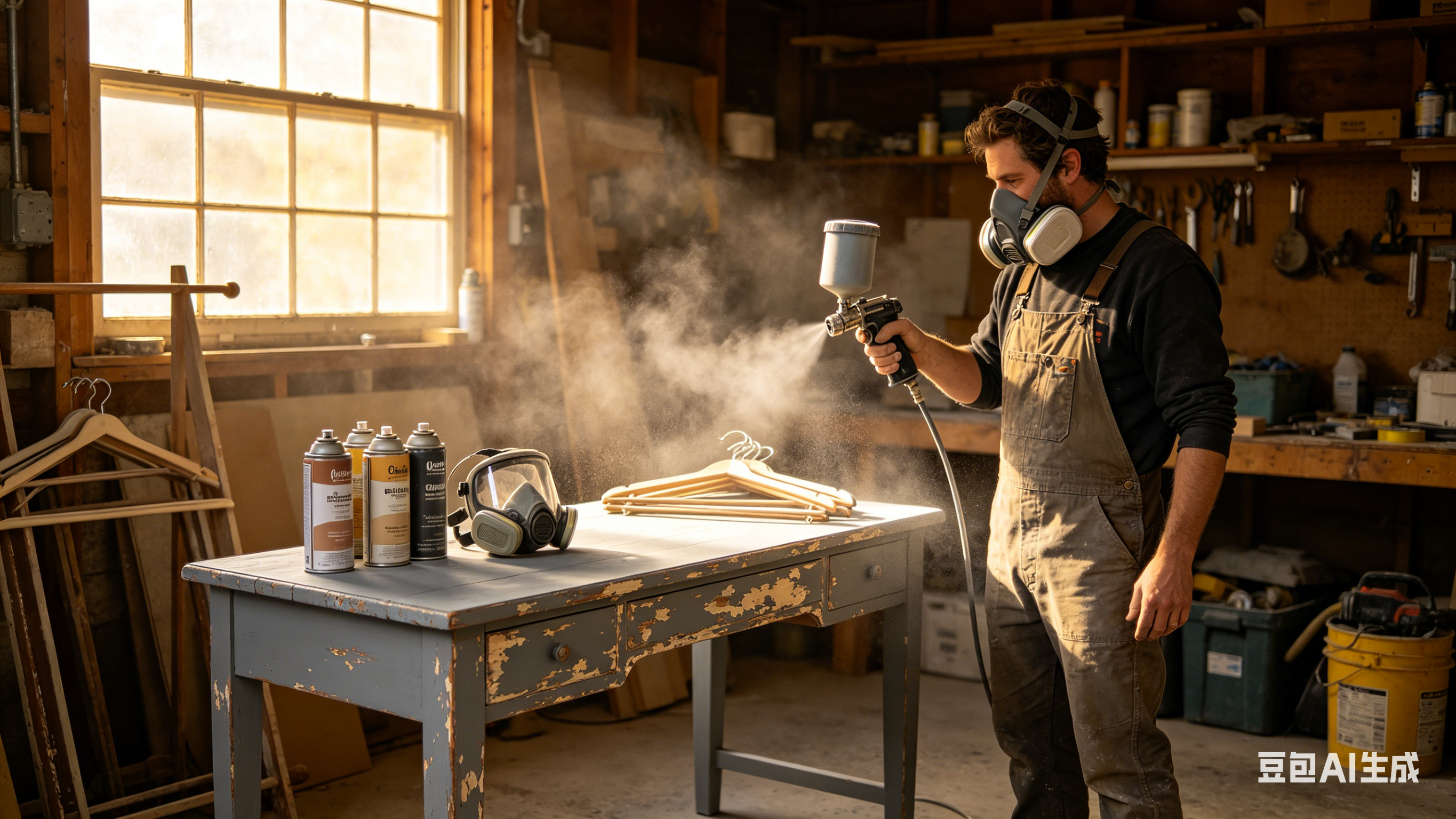

Spray painting seems simple, but eight out of ten beginners encounter the same problems on their first try. Don't worry — in most cases, it's not the spray gun's fault, but a matter of technique. Below are the 5 most common problems and their solutions.
Problem 1: Runs / Sags
Appearance: Tear-like streaks or drips on the painted surface, sometimes flowing down like a waterfall.
Causes:
-
Spray gun too close to the workpiece (<10cm)
-
Moving too slowly, pausing too long in one spot
-
Too much paint output per pass (flow control knob opened too wide)
-
Paint too thin (over-diluted)
Solutions:
| Step | Action |
|---|---|
| ① | Maintain a distance of 15-20cm between gun and workpiece |
| ② | Keep moving speed at approximately 30cm/second — don't hesitate or stop |
| ③ | Follow the "thin coats, multiple layers" principle — apply only a thin layer per pass |
| ④ | If runs have already occurred, wait for the paint to dry completely, then sand smooth and repaint |
💡 Tip: Beginners should practice distance and speed on scrap cardboard or old wood first to get a feel before moving to the actual workpiece.
Problem 2: Orange Peel / Rough Surface
Appearance: The dried paint surface looks bumpy like an orange peel and lacks gloss.
Causes:
-
Paint too thick, insufficient thinning
-
Spray pressure too low, poor atomization
-
Spray gun too far away (>25cm), paint mist partially drying in mid-air
-
Nozzle size mismatched with the paint type
Solutions:
| Step | Action |
|---|---|
| ① | Thin the paint correctly according to instructions — typically paint:water ≈ 5:1 for water-based paints, paint:thinner ≈ 4:1 for solvent-based paints |
| ② | Check compressor pressure, set to 0.4-0.6 MPa |
| ③ | Reduce spraying distance to 15-20cm |
| ④ | For mild orange peel, wet sand with 2000-grit sandpaper then polish |
💡 Tip: Using a viscosity cup is the most accurate way to check paint thickness. If you don't have one, dip a stir stick in the paint — it should flow off in a continuous, unbroken stream.
Problem 3: Grainy Texture / Sandiness
Appearance: The dried surface feels rough to the touch, like fine sand stuck to it.
Causes:
-
Dusty spraying environment — airborne dust adheres to the paint mist
-
Workpiece surface not cleaned properly
-
Spray gun too far away — paint mist partially dries into particles
-
Paint contains impurities or lumps
Solutions:
| Step | Action |
|---|---|
| ① | Thoroughly clean the workpiece before spraying — wipe with a damp cloth and let dry |
| ② | Wipe again with a tack cloth just before spraying to pick up fine dust |
| ③ | Close doors and windows to reduce airflow that carries dust — lightly mist water in the air to settle dust |
| ④ | Strain the paint through a filter before use to remove impurities |
| ⑤ | Cover the workpiece immediately after spraying to protect it from dust while drying |
💡 Tip: A bathroom can be a decent temporary spraying area — higher humidity and less dust — but make sure ventilation is adequate.
Problem 4: Fish Eyes / Cratering
Appearance: Small round dimples or craters in the paint surface, like miniature volcanoes exposing the layer underneath.
Causes:
-
Oil, wax, or silicone contamination on the workpiece surface (most common)
-
Water or oil in the air hose
-
Sweat or hand lotion transferred from fingers to the workpiece
Solutions:
| Step | Action |
|---|---|
| ① | Wipe the workpiece thoroughly with degreaser or industrial alcohol before spraying |
| ② | Wear clean gloves while handling the workpiece |
| ③ | Install a water/oil separator between the compressor and spray gun |
| ④ | Drain accumulated water from the compressor tank daily before use |
| ⑤ | Once fish eyes appear, you must sand down to the primer layer and repaint |
💡 Tip: To check for silicone contamination, try the "water break test" — sprinkle water on the surface. If water beads up and rolls off instead of forming a continuous film, the surface has oil contamination.
Problem 5: Poor Coverage / Translucency
Appearance: The substrate is still visible after spraying — uneven coverage.
Causes:
-
Painting too thin (beginners are often afraid of runs and spray too conservatively)
-
Paint has poor hiding power (bright colors like reds and yellows, for example)
-
Uneven movement speed during spraying
-
Insufficient overlap between passes
Solutions:
| Step | Action |
|---|---|
| ① | Don't be afraid to increase the number of coats — use 3-4 thin layers to build coverage |
| ② | The first coat can be extra thin (about 30% coverage), then build up with subsequent coats |
| ③ | Maintain 30%-50% overlap — each pass should cover the edge of the previous one |
| ④ | For colors with poor hiding power, spray a matching primer first as a base |
| ⑤ | When spraying light colors over dark substrates, apply a white or gray primer first |
💡 Tip: To check if coverage is complete, look from different angles — under direct light and side light. Even, with no transparency visible, means it's good.
Quick Reference Table: Problem Causes in One Sentence
| Problem | One-Sentence Cause | Quick Fix |
|---|---|---|
| Runs/Sags | Too close + too slow + too thick | Increase distance, speed up, use thin multiple coats |
| Orange Peel | Paint too thick + distance too far + pressure too low | Add thinner, reduce distance, increase pressure |
| Grainy Texture | Dusty environment + distance too far + dirty paint | Clean area, strain paint, maintain 15-20cm distance |
| Fish Eyes | Oil contamination + water in air line | Degrease surface, install water/oil separator |
| Poor Coverage | Sprayed too little + coat too thin | Add more coats, maintain proper overlap |
Final Advice
Spray painting is a skill that comes with practice. No amount of tutorials can replace getting your hands dirty and practicing a few times.
Recommended steps for beginners:
-
Practice on scrap material first — old wood boards, cardboard boxes, scrap metal
-
Change only one variable at a time — distance, speed, pressure, or flow rate — not all at once
-
Keep a log of successful settings — write down the paint thinning ratio, pressure, and technique that worked for you
By the time you finish your fifth project, looking back at these problems, you'll realize — none of them was really that difficult.
🔩 Found Your Ideal Nozzle Size? Get It Here.
The HYCHIKA 4-Piece Nozzle Set includes the most commonly used sizes — so you're always ready for any paint, any surface, any project.
🛒 Shop HYCHIKA 4-Piece Nozzle Set View 1.2mm Precision Tip →Fits HYCHIKA 600W HVLP series · Multiple sizes for different paint types