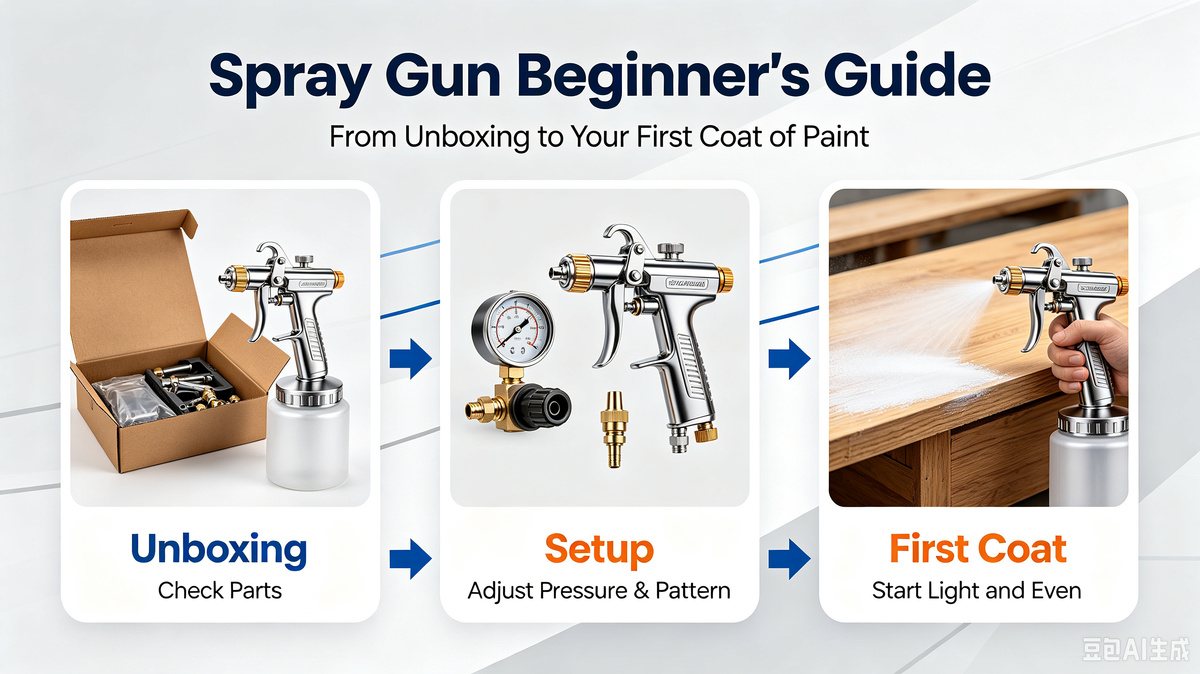
"I spent all afternoon brushing a wooden board. My arms ached, my back hurt, and when it dried — brush marks everywhere."
Does that sound familiar?
If you've ever painted furniture, cabinets, or models with a brush, you know the frustration. That's why so many DIYers and professionals are asking the same question:
"Should I switch from a brush to a spray gun?"
The short answer? Yes — if you care about speed, quality, and comfort.
Here are 5 reasons why once you try a spray gun, you'll never pick up a brush again.
1. No Brush Marks – Get a Factory-Quality Finish
The most annoying thing about brushing is brush marks.
No matter how expensive your paint or how steady your hand, brushes almost always leave visible strokes. This is especially painful with glossy paints, varnishes, and clear coats — they look terrible under light.
A spray gun solves this completely.
It turns liquid paint into a fine mist of tiny particles. Those particles land evenly across the surface and dry into a smooth, seamless layer. No streaks. No strokes. No texture.
👉 You get results that look like factory-sprayed finishes — not "hand-painted."
SEO keyword cluster: spray gun finish quality, no brush marks, smooth paint application
2. Work 2x Faster – Save Hours on Every Project
Let's compare.
With a brush:
Paint one side of a cabinet door → wait for it to dry → flip → paint the other side. Add constant dipping, smoothing, and edge work. A single door can take an hour or more.
With a spray gun:
Turn on the air compressor → pull the trigger → two passes and one side is done. A full cabinet door takes minutes, not hours.
If you refinish furniture, build models, or paint multiple items, the time difference is massive.
Brushes are "slow and steady." Spray guns are "fast and flawless."
3. Easy Coverage on Complex Shapes & Tight Corners
Brushes work fine on flat surfaces. But what about:
-
Carved chair legs?
-
Louvers and grilles?
-
Inside corners and deep recesses?
Brushes simply can't reach these areas properly. You end up using small detail brushes, fighting drips and uneven coverage.
A spray gun handles everything.
Because it uses atomized airflow, paint mist naturally flows into every gap, corner, and crevice. As long as you can point the nozzle, you get even coverage — no missed spots, no pooling.
👉 Your project finally looks complete — with no "I couldn't reach there" marks.
4. Thinner, Stronger, More Durable Paint Film
Here's a hidden problem with brushes: you almost always apply paint too thick.
Why? Because you need enough paint on the brush to spread it evenly. The result is a thick coat that:
-
Dries slowly
-
Wrinkles easily
-
Has lower adhesion
-
Cracks over time
A spray gun applies thin, uniform coats.
Each layer is as thin as a sheet of paper. But by building up multiple thin layers (2–3 coats), you get a final paint film that is actually stronger, more flexible, and more durable than a single thick brushed coat.
For automotive paint, wood finishes, and model painting, the spray gun is the clear winner.
5. Work Comfortably – No More Back Pain or Awkward Postures
Let's be honest: brushing is physically uncomfortable.
-
Painting high areas? You're on your tiptoes.
-
Painting low areas? You're bent over.
-
Painting large surfaces? Your arm and shoulder are constantly working.
After an hour or two, your back, neck, and arms hurt.
With a spray gun, you stand up straight and work naturally.
The gun is lightweight. The trigger requires almost no force. You maintain a comfortable 15–20 cm (6–8 inches) distance from the surface. For large areas like walls, tabletops, or cabinet panels, you can move like you're sweeping the floor — relaxed and efficient.
This isn't just about comfort — it's about your long-term health. Why suffer when you don't have to?
What About the Downsides of Spray Guns?
To be fair, spray guns aren't perfect for everyone. Here are the real cons:
| Downside | Why It Matters |
|---|---|
| Higher upfront cost | You need a spray gun + air compressor + regulator + hoses |
| Learning curve | You must practice technique, thinning, and pressure settings |
| Cleaning takes longer | Thorough cleaning after every use is mandatory |
| Overkill for tiny jobs | For a small stool, cleaning the gun takes longer than painting |
But here's the truth:
If your projects are more than occasional touch-ups — or if you care about professional results — these downsides are easily outweighed by the 5 benefits above.
SEO keyword cluster: spray gun disadvantages, is a spray gun worth it, spray gun for beginners
Conclusion: Brushes Still Have a Place — But Spray Guns Are the Future
Let's be clear: brushes aren't useless.
They're still great for:
-
Small touch-ups
-
Applying wax or oil finishes
-
Artistic brush effects
But if you ask: "I want the best quality, fastest speed, and most comfortable experience for my next project — what should I use?"
The answer is clear: a spray gun.
The first time you spray a smooth, even, brush-mark-free finish, you'll smile. And then you'll understand why thousands of DIYers and pros have made the switch.
Once you go spray, you never go back.
FAQ – Spray Gun vs Brush
Q: Is a spray gun better than a brush for furniture painting?
A: Yes — especially for smooth finishes, curved surfaces, and large pieces.
Q: Do I need an air compressor for a spray gun?
A: For HVLP spray guns, yes. You also need a regulator and water separator.
Q: Can a beginner use a spray gun?
A: Absolutely. There's a learning curve, but most people get good results after 15–20 minutes of practice on cardboard.
Q: How much does a basic spray gun setup cost?
A: A beginner kit (spray gun + small compressor) starts around $100–150 USD.
Q: Is cleaning a spray gun really that hard?
A: It takes 5–10 minutes of thorough cleaning after each use. Not hard — just mandatory.
Ready to Make the Switch?
If this article convinced you to try a spray gun, here's what to do next:
-
Buy a beginner-friendly HVLP spray gun (gravity feed recommended)
-
Get a small air compressor (7–10 liter tank minimum)
-
Practice on cardboard before your real project
-
Learn to clean your gun properly — it's the secret to long life